Your Battery is Just the Beginning — GridPilot Runs the Whole Property
SmartMotion GridPilot · Case Study · South Australia
Most people think of a home battery as a bucket that fills with solar and empties at night. The Smart Motion GridPilot Power Plant is something fundamentally different — an AI-driven energy broker that manages your battery, your pool, your spa, and every flexible load on your property, all scheduled around the cheapest power available.
It Starts With a Simple Question
When is electricity actually cheapest today? And what should be running right now to take advantage of it?
Standard solar and battery setups can’t answer that. They follow a fixed schedule — charge during the day, discharge at night, export when the battery’s full. That’s fine, but it leaves a surprising amount of money on the table, especially in South Australia where wholesale electricity prices swing dramatically across the day. Sometimes they go negative — the grid is paying you to use electricity. Sometimes they spike to many times the normal rate during demand events. A fixed schedule misses all of that.
GridPilot was built specifically to answer that question, every five minutes, automatically.
GridPilot doesn’t schedule around a clock. It schedules around the price of power — and that changes everything.
The Battery Brain: AI-Driven Arbitrage
At its core, the GridPilot Power Plant is a battery arbitrage engine. It pulls 5-minute wholesale price forecasts from Amber Electric or LocalVolts, reads every sensor on the property through Home Assistant, and passes all of that context to an AI model that applies a detailed decision framework. Every decision comes back as one of three modes:
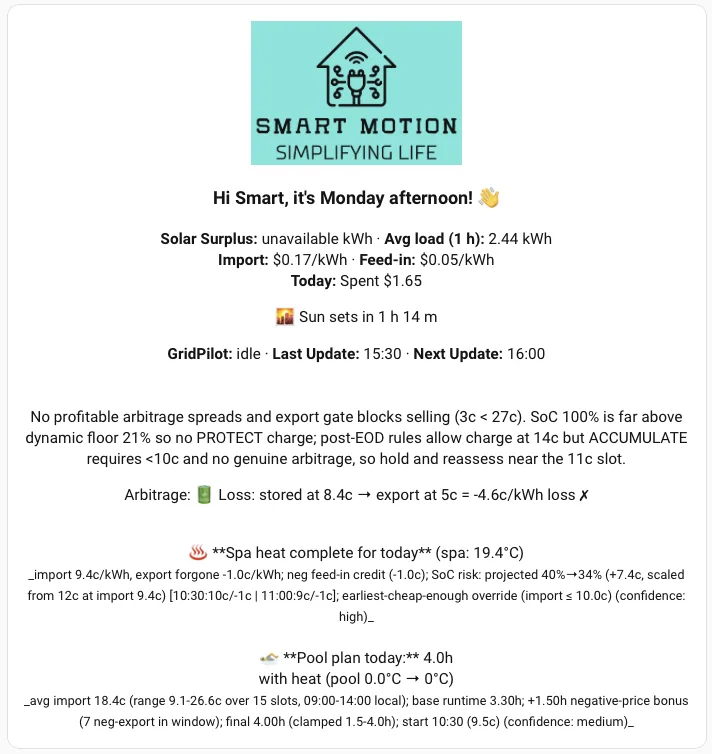
Charge — Buy energy now. Triggered when prices are cheap (under 10c/kWh), when they’re negative (you’re being paid to take energy from the grid), or when there’s a profitable arbitrage spread coming up in the next few hours. The system calculates the exact net profit after the battery’s round-trip efficiency loss before deciding to act.
Export — Sell stored energy at a profit. Only triggered when the export price exceeds the true blended cost of what’s in the battery, plus efficiency losses and a margin. GridPilot never exports at a net loss — it knows exactly what was paid to store that energy.
Idle — Wait for a better opportunity. Self-consume solar, hold reserves for the evening peak, and watch for a worthwhile move. Often the smartest decision of all.
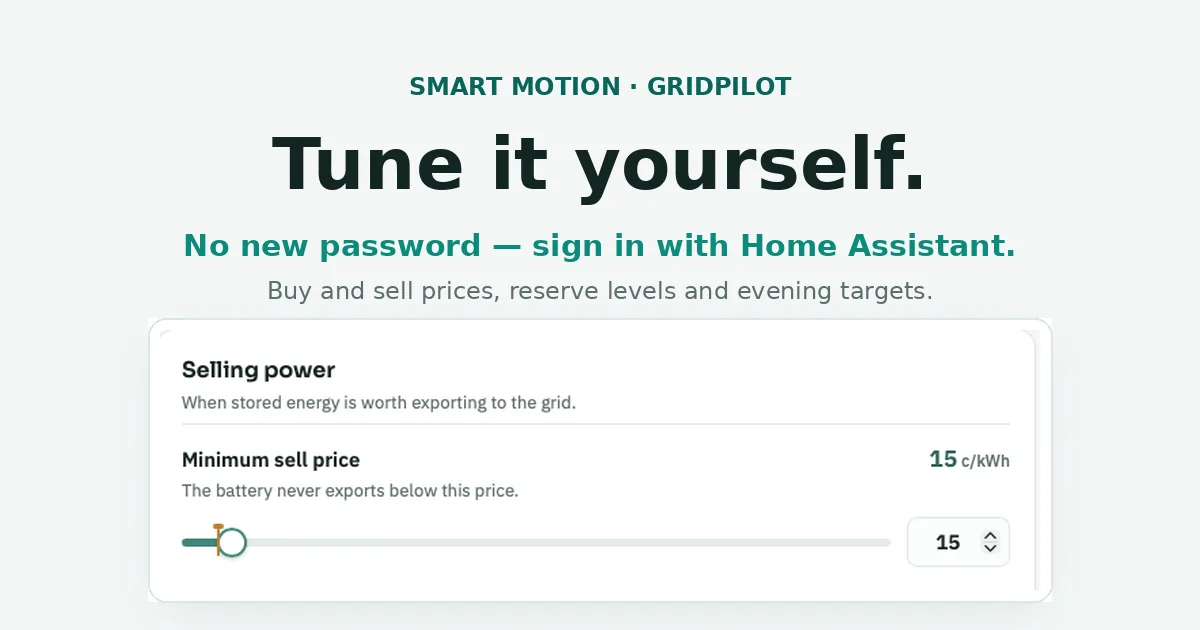
Underpinning all of this is a dynamic battery reserve floor — a minimum state of charge calculated from how much energy the household will need before cheap prices return. The system never exports below that floor, protecting the home from expensive grid imports during the evening peak when it matters most.
Why Wholesale power Makes This Possible
Amber Electric or LocalVolts passes the actual wholesale spot price through to customers, plus a small fixed margin. That means prices can go negative — regularly, in South Australia, with high renewable penetration. It also means prices can spike dramatically during demand events when the grid is under stress.
GridPilot is built for exactly this environment. It detects demand windows and blocks charging to avoid contributing to grid stress. It activates export during price spikes to earn strong returns. And when prices go negative, it actively charges — sometimes getting paid just to fill the batteries while other households are inadvertently sitting on peak rates.
Pool Pump: Scheduled Around the Price, Not the Clock
The pool pump is one of the bigger loads in a typical home — and one of the most flexible. It doesn’t care whether it runs at 9am or 11am, as long as it runs. That makes it a perfect candidate for price-aware scheduling, and GridPilot takes full advantage.
Every morning at 8:30, GridPilot analyses the wholesale price forecast across the expected pump run window and calculates two things: how long to run the pump today, and exactly when to start it.
Runtime scales between 1.5 and 4 hours based on the forecast average price — cheaper days get longer runs, expensive days get the minimum needed for filtration. There’s also a bonus runtime for days with negative-price slots (where running the pump is literally free or revenue-positive), and for days with large projected solar surplus where the energy is essentially sitting there unused.
Rather than a fixed 9:30am start, GridPilot selects the earliest forecast slot at or below its price preference threshold and pushes that start time to GridPilot. The pump automation then has three ways to trigger: the GridPilot-chosen start time, an early trigger if the battery hits 35% charge first (meaning solar has already banked enough free energy to run the pump), or a 1pm backstop on bad-forecast days to guarantee the pump still gets its minimum filtration run regardless.
Spa: Heated at the Cheapest Possible Window
The spa heater is a significant load — bringing water up to 40°C takes real energy. GridPilot’s spa scheduler, running at 8:40am each morning, uses a multi-factor scoring model to find the optimal 60-minute heating window for the day.
The scoring considers the weighted grid import cost across each candidate window, the solar export opportunity cost (what you’d earn by exporting instead of heating), negative feed-in credits if export pricing is negative, a curtailment bonus when surplus power has nowhere useful to go, and a battery risk penalty that scales down when import prices are already cheap. There’s also an “earliest-cheap-enough” override — if any window has an average import price at or below the preference threshold, it picks the earliest rather than endlessly hunting for a perfect minimum.
The chosen start time is pushed to Home Assistant, which then fires the full spa sequence — switching the solenoid valve to spa position, setting the heater to 40°C, running the pump, and safely returning everything to pool mode once the cycle is complete. The heater automatically targets 25°C in pool mode and 40°C in spa mode, with no manual switching required.
Curtailment: When the Grid Doesn’t Want Your Power
South Australia regularly sees negative feed-in prices — the wholesale market charges exporters to push power into a grid that’s already oversupplied with renewables. When that happens and the battery is full, GridPilot curtails PV export by capping both inverters to match house load only, preventing revenue-negative exports.
At the same time, it looks for ways to absorb that surplus locally. The pool heater is the primary dump load — when export prices are negative and the battery is full, the heater fires to soak up the surplus solar that would otherwise be curtailed. The moment curtailment ends or the battery needs a top-up, normal operation resumes automatically.
Demand Window Response
Network stress events can push prices to extreme levels. When a demand window is active, GridPilot immediately blocks all battery charging to avoid contributing to grid stress and drawing expensive power. It also applies a preventive charge block for the following 24 hours during peak evening hours, since demand events tend to cluster on hot days.
During a demand event, the system can still export at strong prices if the economics are favourable — turning a grid stress event from a potential cost into an earnings opportunity.
End-of-Day Battery Readiness
GridPilot doesn’t just optimise for right now — it plans ahead to ensure the battery is well-charged by mid-afternoon, ready for the evening peak period (5–9pm) when grid prices are typically highest and household demand peaks.
It calculates how much solar generation is likely to remain for the day (derated for cloud variability), compares that against what’s needed to reach the target state of charge, and figures out whether a grid top-up is needed and how urgently. If solar can cover it, the system holds off. If there’s a shortfall approaching the target time, it charges — but applies a price ceiling to ensure the top-up doesn’t cost more than the evening arbitrage is worth.
More Than a Battery Controller
What the GridPilot Power Plant delivers is a shift from passive energy management to active energy participation. The property isn’t just consuming solar and storing the rest — it’s responding to wholesale market signals in real time, running flexible loads at the cheapest possible moments, and treating every kilowatt-hour as a resource to be deployed intelligently.
The pool runs when power is cheapest. The spa heats during the optimal morning window. The batteries charge when prices go negative and export when they spike. Curtailment activates when the grid can’t cope. The household never runs flat and always has reserves for the evening peak.
That’s what a SmartMotion GridPilot Power Plant looks like — and it’s available for your property right now.
Interested in a GridPilot Power Plant? Get in touch with the SmartMotion team.